KALI DASGUPTA
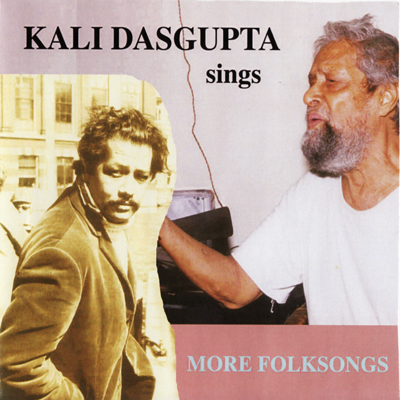
KALI DASGUPTA sings MORE FOLKSONGS
(Double CD)
Notes from the CD
KALI DASGUPTA (1926-2005)
Kali Dasgupta is among the greatest collectors and interpreters of the folksongs of eastern and northeastern India. He was actively involved in politics during the independence movement and up to 1965. His interest in folk music grew alongside his political involvement for such songs reveal the socioeconomic condition of the people; the oppression both feudal and political against which they struggle. In 1965 Kali moved to England where he came to know many singers who shared his perspective, particularly Ewan McColl and Peggy Seeger. He began to perform regularly in folk clubs both in the U.K. and the U.S.A. On his return to India he continued to collect, perform and teach.
Kali accompanies himself on a four stringed instrument - the dotara. He also plays a one stringed gourd-the ektara.
Lokosaraswati thanks Arun Nag, Partha Sarathi Chatterji, Stan Scott and Jack Warshaw who originally recorded the songs that make up this album. The songs from Goalpara come from the collection of Nihar Barua. In the songs from Purulia the accompanist on the sarengi is Nilanjan Halder.
CD1
1. [play mp3 or ] Bihu (Assam) These quatrains are sung at the Bihu (Spring) festival.
2. [play mp3 or ] Amarei moina shuboiye (Assam) A lullaby.
3. [play mp3 or ] Horiherorei (Assam) A devotional song.
4. [play mp3 or ] O Balaram (gostholila song, Sylhet) Yasoda asks Balaram to leave. She does not want to let Krishna go with him and the cowherds. She cannot bear to lose him.
5. [play mp3 or ] Kandey rakhal gonei (gostholila song, Syihet) Yasoda is crying to Krishna's companions who reply that they cannot go to the cattle fair without Krishna.
6. [play mp3 or ] Dubi,dubi mon (written in jail in the 1930s by Sishtidhar Mahatao a freedom fighter and leader of the Purulia Baul movement). The singer is searching to find who he is and where he has come from. His senses do not help him. In his heart is a lotus full of honey but he can get no trace of it. He will devote himself to his guru - his gods - hoping to find the truth.
7. [play mp3 or ] Baccharei na neo dur bone (gostholila song, Sylhet) Yasoda begs Balaram not to take Krishna far away into the forest.
8. [play mp3 or ] Nander nandon (gostholila song, Syihet) Nandan's son, Krishna, is going to the fields playing the flute.
9. [play mp3 or ] Swapane paiachi hon (dorbanijhumur, Purulia) The singer complains of the fickleness of her lover who has brought her shame and distress by his unfulfilled promises.
10. [play mp3 or ] O Shyam kalia rei (bhawaiya, North Bengal) Like many love songs the lovers are idealized as Radha and Krishna. [See also CD 1 nos 13, CD 2 nos 4,16] The singer (Radha) is trying to allure her lover (Krishna) by drawing attention to her looks and qualities which she says surpass his.
11. [play mp3 or ] Jhingalate komor ben (Purulia) A farmer complains to his daughter-in-law that she has brought his food to the field very late. She replies that she has to do all the work alone for she is badly treated by her mother-in-law and sister-in-law. The farmer promises that he will buy her a silver chain at the weekly market.
12. [play mp3 or ] Chayir cheejei pinjira (marifati, Sufi song) The singer describes how love creates and unites while hatred causes disintegration. The cycle of creation, growth, decay and regeneration is everywhere in Nature. Only by understanding the feeling of a lover can one empathize with the agony of an animal which has been separated from the herd.
13. [play mp3 or ] Aashar o sarabon maashei (Purulia; written by Binondia Singh about 200 years ago) It is the rainy season,the river has overflowed. How can the singer keep his promise to meet his lover on the far bank. Just as the river flows on so have friends gone away. If he meets his beloved he will put a red flower in her hair.
14. [play mp3 or ] Naiyaba sujon nayia (bhatiali,Bangladesh) The boatman, full of fear that he cannot find his way, must row close to the shore and steer straight for the 3 streams of Triveni. A storm is brewing and it is getting dark. He should not be diverted by the shiny goods in the city bazaar nor by the creditors of Madanganj (the mart of love).
CD 2
1. [play mp3 or ] Godadharer parei parei rei (mahout's song, N.Bengal) The mahout is riding away. His lover asks him to raise his saddle so that when she goes to fetch water she can see him in the distance.
2. [play mp3 or ] Dhoulmorei mai (women's dancing song, Goalpara) A boy requests a girl to elope with him. He will not take "No' for an answer. He will buy the ticket and they will go to Dumni. If there is trouble there they will go to Morujbari where his uncle lives.
3. [play mp3 or ] Magur maacher thuma rei thumi (women's dancing song, Goalpara) Rice and fish must be served. The singers encourage the beautiful girl to dance to the rhythm of their clapping. Her lover iscoming and will bring her a good sari and gold ornaments.
4. [play mp3 or ] Shorol bulia choronu gaache (woman's song, Goa/para) Love here is symbolized by a tree which the singer says she has climbed and cannot get down. Her waterpot breaks so that only the neck remains cradled in her arm. She calls on her god to save her. She clutches her sari. The pot is washed away by the waves.
5. [play mp3 or ] Aji saalmarar tolei (bhawaiya,North Bengal) The bird has flown. Like a bird I should like to fly in search of my beloved.
6. [play mp3 or ] Teer pore jhakere jhake (women's fertility cult song, Goalpara) Bats (destroyers of crops) have roosted in the trees and must be driven away. But no, they do not eat the bananas for the bat (now symbolizing the lover) watches through the leaves and catches a glimpse of a sari and gold earrings.
7. [play mp3 or ] Dhig,rparei, parei (women's dancing song, Goalpara) The peacock boat is sailing on the lake; Krishna is playing his flute. You want me to dance but how can I dance without ornaments and a good sari? Then dance to the tune of Krishna's flute.
8. [play mp3 or ] Rosher bhomra sadu rel (woman's song, Goalpara) A young wife tells her husband, who travels for his business, that he should not flirt with other girls but should concentrate his love on his wife who is alone at home
9. [play mp3 or ] Neechad(Santhali song)
10. [play mp3 or ] O doina (Santhali song) These two songs are sung by the Santhali people at the Shohora (badna winter festival. The crops are safely harvested. It is time to repair and paint the houses. They will wash their clothes in soda and bathe. The festival is approaching with the grandeur of an elephant.
11. [play mp3 or ] Hapa hapa napha rei (Goalpara) The singer has cooked a delicious napha spinach. She falls asleep and the spinach is stolen. The watchman suggests that she complains to the police who will surely frighten the thief into returning the spinach. She does so but to no avail.
12. [play mp3 or ] Jhunjhun mama (Nepal)
13. [play mp3 or ] Dhon, dhon, dhon (Bengal) A Lullaby,
14. [play mp3 or ] Lapalang (Kasi song, Meghalaya) A mother deer laments the death of her young one who could not resist the lure of the fresh green grass and was shot
15. [play mp3 or ] Bala kutir bhai (mahout song, North Bengal) the mahout has invested in an elephant but it is mad and does not work well. He is frightened it may cause him harm. He has a new wife at home and does not want to go to work and leave her.
16. [play mp3 or ] Duareraage doobba ghaash (woman's song, Goalpara) The singer imagines that her lover, idealized as Krishna, is nearby. She sees an aura of bright light. If he does not come she threatens to consume poison.
17. [play mp3 or ] Bapoi changra rei (woman's song, Goalpara) A girl asks a boy to climb a tree and pick two olives, one for her and one for him. He can also pick some for her young brother.
18. [play mp3 or ] Aamerpata mochor (women's dancing song, Goalpara) The mango leaves grow thickly but the bamboo leaf is narrow. have told nobody of our secret love but everyone is whispering about us.
19. [play mp3 or ] Aji aulailen mor (mahout's song, N.Bengal) The mahout remembers the girl he left behind and sings her thoughts: "You have spoilt my household. You understand the mind of an elephant but you do not know a woman's heart."